

 Annual cost, line by line
 Minimum terms and exit charges
 What the saving does not include
The advertised subscription is only one part of the total cost. A fair comparison includes the plan duration, the number of connections, the hardware you already own, your broadband, and the value of clear support and refund terms. It also has to account for the parts of a traditional package that a subscription service simply does not replace. This page sets the numbers out first, then explains what sits behind them.
Head-to-Head Cost Comparison
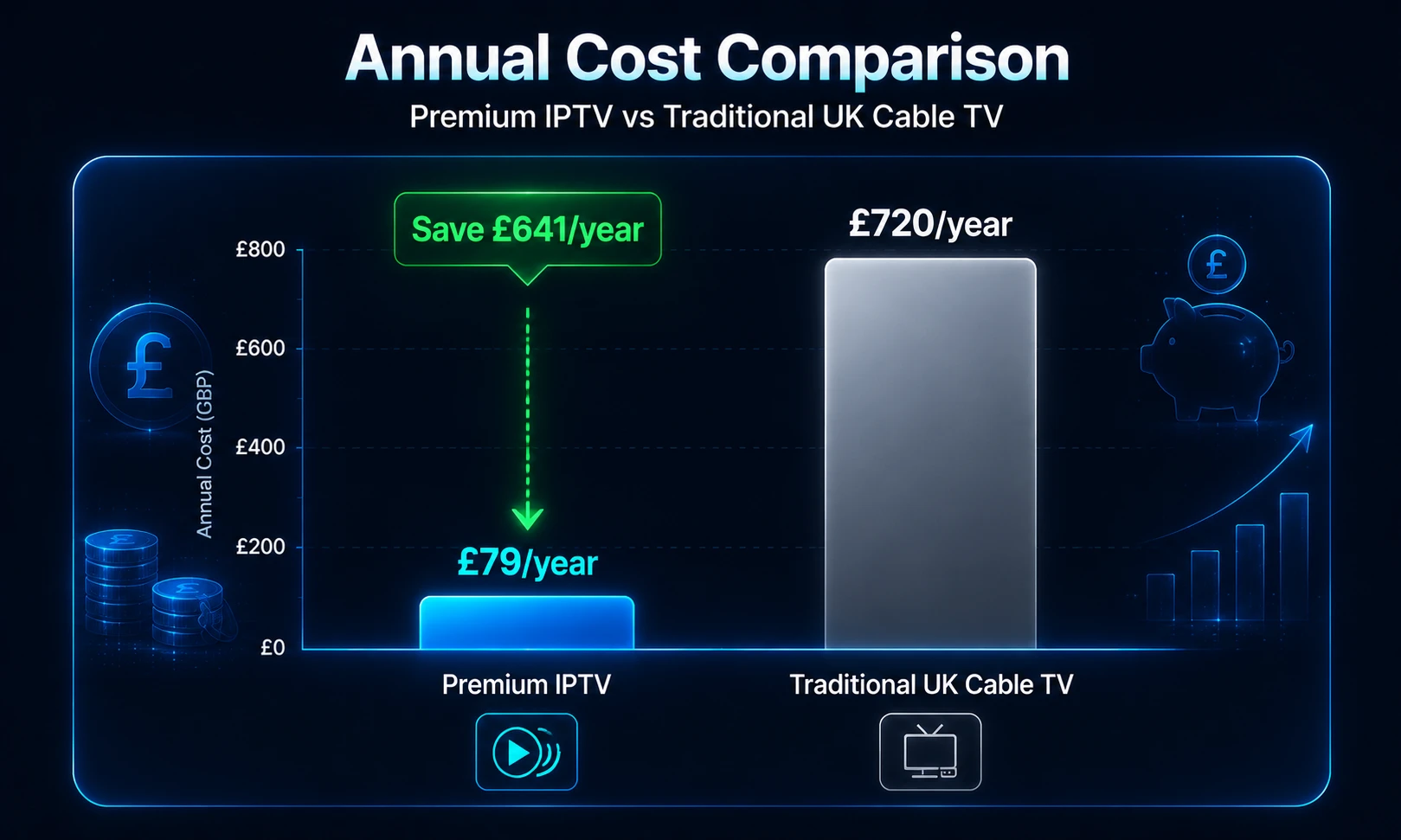
The chart below is the approved annual comparison. Beneath it, the same figures are broken out line by line so you can see which costs are recurring, which are one-off, and which apply to both options equally.
| Cost line | Premium IPTV (12-month, 1 connection) | Traditional UK pay TV (representative) |
|---|---|---|
| Headline subscription | £79.99 for the full twelve months | Around £60 a month, so about £720 over twelve months |
| Minimum term | None beyond the period you buy | Typically 18 or 24 months |
| Mid-contract price rise | None — the price is fixed for the period | Annual in-contract increases are common |
| Early exit charge | None | Normally the remainder of the minimum term |
| Installation or setup fee | None | May apply, depending on package and engineer visit |
| Equipment | Use a device you already own | Box supplied; may be chargeable or returnable |
| Broadband | Existing household connection | Often bundled, which absorbs part of the monthly fee |
| TV Licence | Required for live TV | Required for live TV |
| Twelve-month total | £79.99 | About £720 |
| Difference | About £640 over twelve months, on the subscription line alone | |
Compare IPTV and Cable TV Contract Flexibility
The cost table understates the difference in one respect and overstates it in another. It understates it because the annual figure is not the real commitment: a two-year minimum term commits you to roughly twice that amount, and the exit charge exists precisely to make leaving unattractive. It overstates it because a bundled package is often doing more than one job.
What a minimum term actually means
- Length: UK pay-TV packages are commonly sold on eighteen or twenty-four month minimum terms, with the headline price framed monthly rather than as the total commitment.
- In-contract increases: annual price rises during the minimum term are a standard feature of UK telecoms and pay-TV contracts, so the price you sign up at is often not the price you finish on.
- Leaving early: exiting before the end of the term normally means paying the remaining months, which can be a substantial single charge.
- Renewal: when a term ends, packages frequently roll onto a higher standard rate unless renegotiated.
Fixed-duration IPTV works differently. You buy one, three, six or twelve months, the price is set for that period, and the arrangement simply ends when it ends. That is genuinely useful if your household circumstances change, if you only want a service through a particular sporting season, or if you want to test compatibility before committing further. It also means the shorter plans cost more per month — flexibility is not free, it is just charged differently.
Case Study: A Two-Screen Household Over One Year
Worked example — illustrative scenario
The household: two adults, two televisions in regular use, an existing Fire TV Stick and a Smart TV, and a broadband connection they already pay for and intend to keep either way.
Option A — traditional pay TV. A mid-tier bundle at about £60 a month on a 24-month minimum term. Over the first twelve months that is roughly £720. The commitment, however, is the full term: roughly £1,440 before any in-contract increase, and leaving after twelve months would mean settling the remaining twelve.
Option B — fixed-duration IPTV. A twelve-month two-connection plan at £139.99, covering both screens simultaneously. Their existing devices are used, so there is no hardware purchase. The commitment ends after twelve months.
The twelve-month difference: about £580 on the subscription line, and the shorter option carries no residual obligation into a second year.
What this example does not settle: if their bundle also supplied broadband they intended to keep, part of that £60 was buying broadband, and the true television-only difference is smaller. If they watch content that only a licensed broadcaster carries, the cheaper option does not replace it. This scenario is an illustration built from the figures above, not a customer account.
What the Saving Does Not Cover
A price comparison is only honest if it says what you give up. Three things sit outside the table.
- Bundling. Cable and satellite packages frequently include broadband, a landline and sometimes mobile. If you would keep those anyway, a straight television-to-television comparison overstates the saving.
- Content rights. Licensed broadcasters hold rights to specific channels, competitions and exclusives. A subscription service can only supply what it is authorised to supply, and if a particular competition matters to your household, check that before switching. Our guide to IPTV legality in the UK explains why the provider’s permission to distribute is the question that matters most.
- Installation and support model. A traditional provider sends an engineer and takes responsibility for the line into your home. A subscription service does not, which is fine if your network is sound and inconvenient if it is not.
Calculate Your Savings Now
Open the live pricing page, pick the duration and connection count your household actually needs, and compare the total against your current full-term commitment.
Frequently Asked Questions
Compare the commitment, not the advert
The subscription gap between fixed-duration IPTV and a traditional package is real and substantial, but the number that matters is the one you are actually agreeing to: the full-term total, including any in-contract rise and any exit charge. Work that out for both options, subtract anything bundled that you would keep regardless, and check that the content your household cares about is genuinely available on whichever route you choose. Use only services you are authorised to access.